Population with an improved drinking-water source, NFHS-6
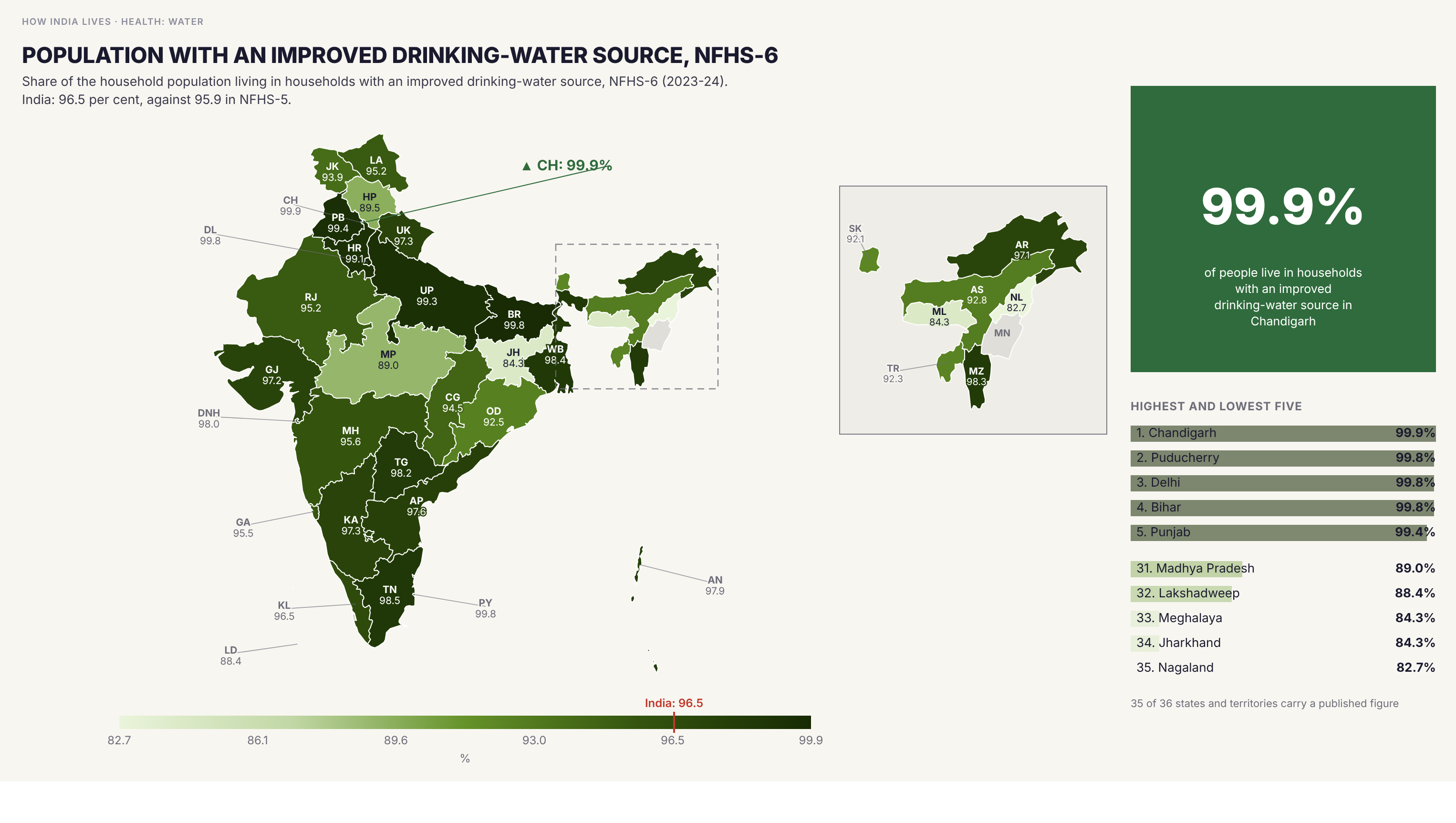
NFHS-6 finds 96.5 per cent of India's household population living with an improved source of drinking water, against 95.9 per cent in NFHS-5. Nagaland (82.7), Jharkhand and Meghalaya (84.3 each), Lakshadweep (88.4), Madhya Pradesh (89.0) and Himachal Pradesh (89.5) are lowest, and Chandigarh, Delhi and Puducherry are highest at 99.8 to 99.9. No state reported in NFHS-6 is under 82 per cent, so the old claim of under 60 per cent in some north-eastern states does not hold on this measure.
Policy implication
An improved source is not safe water. The survey definition counts piped water, tube wells, protected wells, rainwater, tanker trucks and bottled water, and says nothing about contamination, arsenic or fluoride, how many hours water flows, or how far it must be carried. Manipur has no NFHS-6 figure. NFHS-6 is provisional, and some state changes are large (Nagaland down 8.3 points, Himachal Pradesh down 6.7), which should be read with that in mind.
An improved source is not safe water. The survey definition counts piped water, tube wells, protected wells, rainwater, tanker trucks and bottled water, and says nothing about contamination, arsenic or fluoride, how many hours water flows, or how far it must be carried. Manipur has no NFHS-6 figure. NFHS-6 is provisional, and some state changes are large (Nagaland down 8.3 points, Himachal Pradesh down 6.7), which should be read with that in mind.
Data vintage. This map uses NFHS-5 (2019-21). NFHS-6 (2023-24) state fact sheets were released in May 2026, but they are provisional and report fewer indicators, so the figures here have not been replaced.
Source: NFHS-6 (2023-24) (2023-24). See the methodology for notes and limitations.
Part of ImpactMojo. Maps are pedagogical tools for facilitated discussion, not standalone data references. CC BY-NC-SA 4.0.