Rice and sugarcane share of rice, sugarcane and coarse cereal area, 2024-25
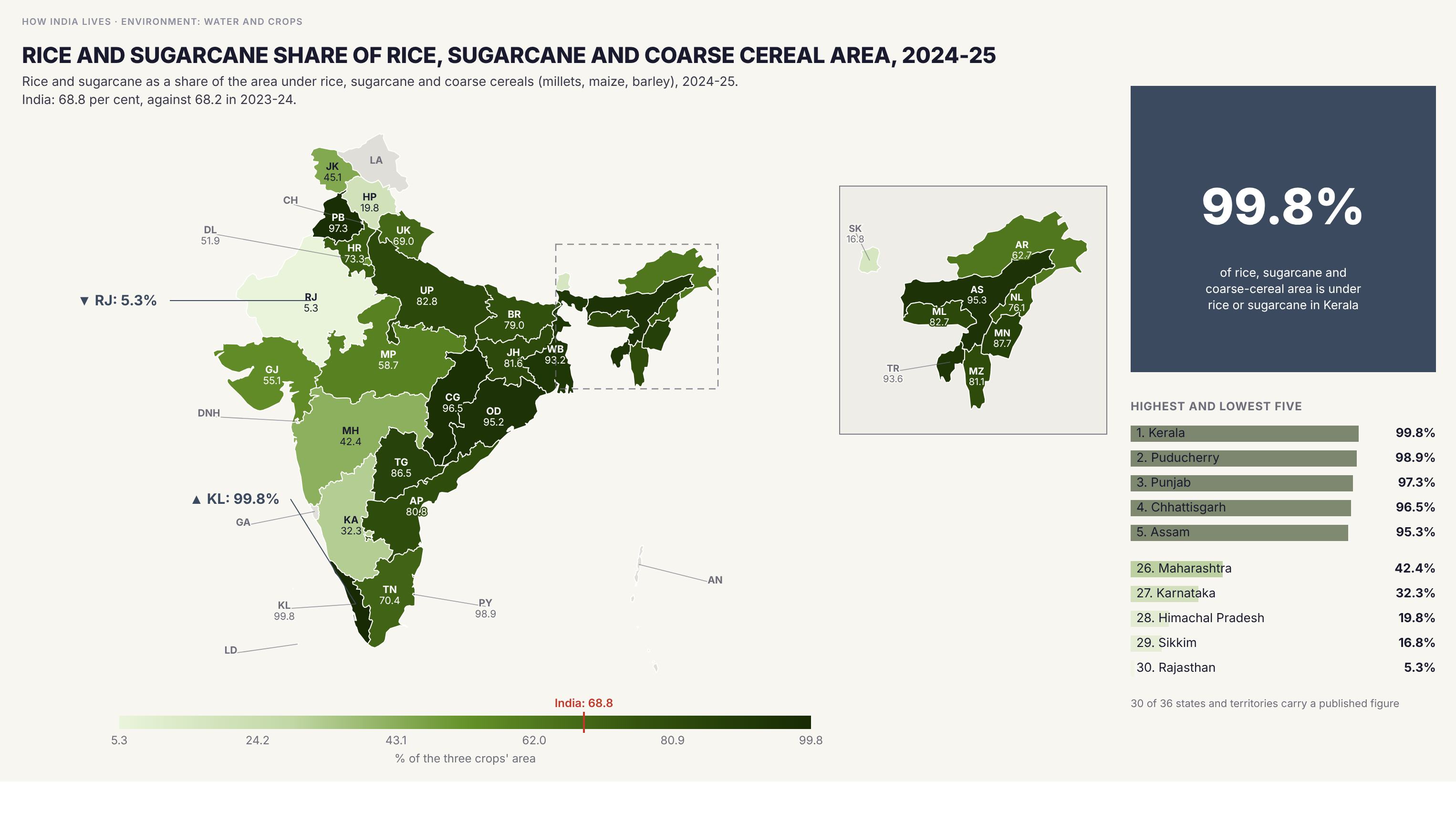
Rice and sugarcane take 68.8 per cent of the area under rice, sugarcane and coarse cereals in India in 2024-25, up from 68.2 per cent the year before. Punjab is at 97.3 per cent, which is 36 hectares of rice and sugarcane for every hectare of coarse cereals. Haryana is at 73.3 per cent, 2.7 to 1, so the old map's ten to one for Punjab and Haryana together does not hold for Haryana. At the other end are Rajasthan (5.3 per cent), Sikkim (16.8) and Himachal Pradesh (19.8).
Policy implication
Rice and sugarcane are the two crops that draw most irrigation water, and coarse cereals are the dryland alternative, but this is a share of three crop groups and not a water measure. Kerala (99.8) is high because coconut, rubber and spices are outside these groups, and wheat, pulses, oilseeds and cotton are outside too. Coarse cereals include maize and barley as well as millets. Goa has no coarse-cereal area in the source and is left out.
Rice and sugarcane are the two crops that draw most irrigation water, and coarse cereals are the dryland alternative, but this is a share of three crop groups and not a water measure. Kerala (99.8) is high because coconut, rubber and spices are outside these groups, and wheat, pulses, oilseeds and cotton are outside too. Coarse cereals include maize and barley as well as millets. Goa has no coarse-cereal area in the source and is left out.
Data vintage. The figures are for 2024-25 and have not been refreshed since this map was made.
Source: Ministry of Agriculture via RBI Handbook 2024-25 (2024-25). See the methodology for notes and limitations.
Part of ImpactMojo. Maps are pedagogical tools for facilitated discussion, not standalone data references. CC BY-NC-SA 4.0.